Booked For Debate: Is TKO Enshittifying WWE?

Wrestling columnists talk too much. Homeboy, we never shut up…
I don’t have much time for this anymore, though I do still enjoy writing. However, in the same light, I’m sort of tired of listening to myself talk. I wouldn’t even consider me “back”, but more as just an old columnist passing by, and dependent on my personal life (very busy, but very good), I may or may not hang around. Hell, you may not see me after this for another 10 months.
But I’m here now. However, I wanted to do something different this time.
So much like Motley Cruz turned the tables on Jumpin’ Jeff Farmer, why not turn the tables on pro wrestling columns? Let’s create something that is meant for discussion, and not for certain columnists to give their third grade grammar level (I HAVE TO WRITE IN CAPS BECAUSE I’M NOT ALLOWED TO YELL AT STRANGERS IN PUBLIC ANYMORE), self-serving articles to crash out at everyone over.
So the formula is simple: I will pose a question, and with this question will be three points. These three points may be what I personally perceive. However, the entire idea is for the discussion to take place here in the comments section, social media, and maybe even NoDQ Live.
To add, there will be something called the “Knee-Jerk” counter argument. A case where the other side of this argument will be presented first. A way for all sides to be presented to the best of my ability.
So with that…
–
Knee-Jerk Counter Argument | TKO is OK (It’s Just Business)

Professional wrestling has always been profit-driven, even though scale and structure of TKO represent a major shift from most of wrestling history. In earlier eras of wrestling, territorial promotions in the 1970s and 1980s, and even the national expansion of WWE under Vince McMahon, were still centrally controlled entertainment/wrestling businesses.
From Gagne (AWA) to Heyman (ECW) to even Bischoff (WCW), these promotions were driven by the instincts of the promoters rather than by large-scale corporate shareholder expectations.
But maybe that’s not a bad thing…
TKO operates more like a modern media conglomerate, emphasizing quarterly growth, global licensing, rights fees, sponsorship integration, and operational efficiency at a scale wrestling historically never experienced. As a result, profits are at record highs and business is better than ever — even compared to the Attitude Era.
Because of this, the modern system is arguably more sustainable financially than most prior wrestling eras. A few roster cuts and more ads/higher ticket prices are a small price to pay for pro wrestling longevity, right?
So is TKO Enshittifying WWE? Let’s continue with more discussion…
–
What is Enshittification?
The term “enshittification”, coined by Cory Doctorow, refers to the gradual degradation of a service as it shifts from serving users to extracting maximum profit from them. According to Doctorow, this occurs in stages:
Early stage (user-focused)
-The service is high-quality, useful, and often generous to attract users.
Growth stage (balance)
-The platform begins monetizing but still tries to keep users satisfied.
Late stage (profit-maximizing)
-The company shifts heavily toward extracting value—often at the expense of users and partners.
Examples
Facebook (and other platforms) evolved from a clean, user-focused feed into one saturated with ads and algorithmically promoted content designed to maximize engagement and revenue. Uber initially attracted users with low fares and generous driver incentives, but later raised prices and reduced driver compensation as it pushed toward profitability. Amazon shifted from a straightforward retail experience to a marketplace where search results are often dominated by sponsored listings and lower-quality products.
Streaming services such as Netflix similarly shifted from offering broad, relatively stable catalogs at low cost to fragmented content libraries, rising subscription prices, and frequent account restrictions. Fast food chains, including McDonald’s, have also followed a comparable trajectory, with menu simplification replaced by frequent pricing increases, app-driven promotions, and reduced perceived value and quality per item.
Enshittification ensures that…
The concept of competition will allow companies to gradually shift value away from users and partners toward themselves.
Once a service has attracted a large, dependent user base, it can incrementally increase prices, introduce ads, reduce quality, or change rules in ways that extract more revenue while retaining most users due to high switching costs and network effects. This tends to ensure that the slow degradation of experiences that remains “good enough” to preserve dominance (ie; WWE), while concentrating power and surplus within the platform over time.
Are we clear on what enshittification is? Awesome. Let’s dig into the three points of doom…
–
Point #1 | Too Many Ads, Too Little Wrestling, Higher Prices
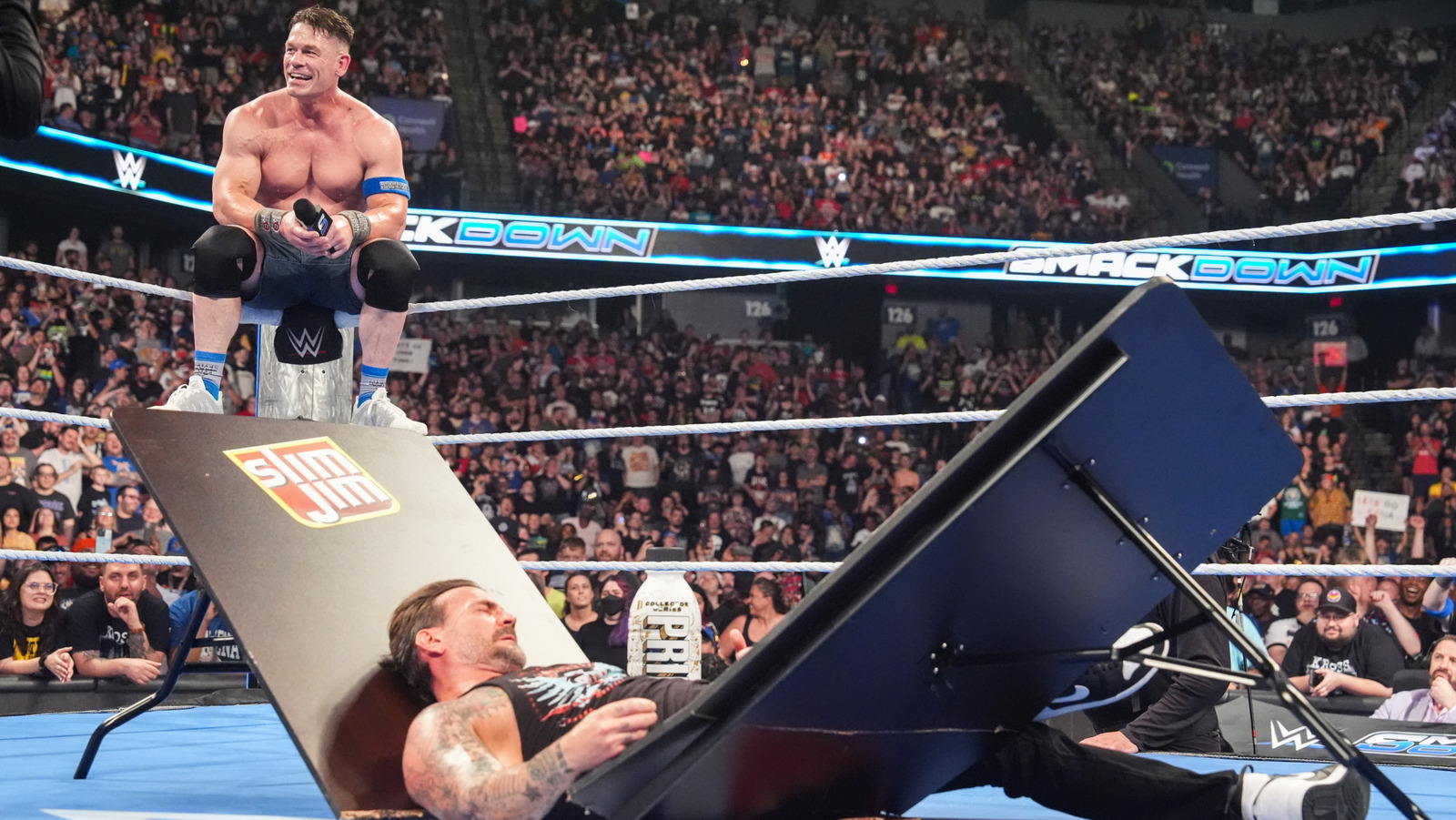
This is the AD-itude Era, right?
It seems as if someone has “TKO’d” match times as well. Look, without watching Wrestlemania 42 I can tell you that if I paid money to watch less than 3 hours of wrestling in a 7 hour show over two nights — I would be a little pissed off.
When someone asks me if my home promotion of AEW has “too much” wrestling I always say “no — it’s wrestling. You’re watching a wrestling show. So there should be mostly wrestling on it.”
I can buy that WWE is the family-friendly promo-first, wrestling-second product. In all reality, for most casual fans and many online WWE fans, that formula has worked for a long time. If I watched WWE programming, I would expect that formula and not an abundance of lengthy matches.
But how little is too little? The amount of actual wrestling clocked in for Wrestlemania 42 was around 37% of the total time for the show. Can you imagine if out of the blue, NBA Commissioner Adam Silver announced that quarters were going to cut from 12 minutes to 8 minutes for the sake of more ads?
No. That would be silly.
But especially since the move to Netflix, in WWE programming, we are notably getting less wrestling, arguably less compelling stories (I’m referring to McAfee’s unneeded involvement in the Rhodes/Orton story as an example), with more promos and more advertisements. And for some, too many celebrities.
And to top it all off — higher ticket prices — for less wrestling and more ads.
And to even top that off — increased prices for premium tiers for WWE PLE’s on ESPN+.
It’s as if TKO is trying to squeeze as much out of the consumer as humanly possible.
Ya’ll good with this? Let me know in the comments below:
–
Point #2 | TKO’s “Enshittification” is Financially Driven
As NoDQ user Miguel pointed out to me earlier, TKO is $4 Billion in debt. Many times, when a company is in debt and continues to shed as much assets as possible, in the form of employment, it sometimes means they are prepping for a sale.
Could TKO be selling WWE in the future, and if so, to whom? Saudi Arabia?
But debt also leads to enshittification. You cut corners, cut quality, and increase revenue anyway you can — especially when it comes to revenue like adding a lot of sponsors in favor of the product itself.
It makes sense. With TKO we have tighter cost control, increased monetization of audiences (increased ticket prices, subscriptions, ads, premium tiers), and operational efficiency measures such as contract restructuring and talent cost management.
So even all of this is “just business”, is that reason to justify the prior enshittification? I personally don’t agree with that, but perhaps you do?
Let me know…
–
Point #3 | The “Vibes” Are Off
Hear me out.
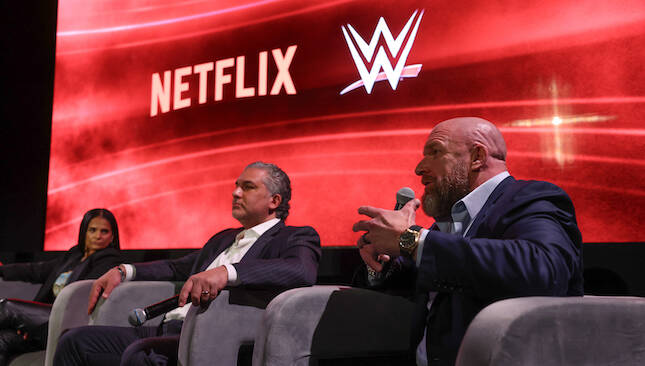
I tuned into the first Netflix Raw well over a year ago. The debut. And well, it felt “off”. Tuning back in here and there recently, it still feels “off”. It’s like the equivalent of NASCAR, where the vehicles are all slapped with sponsorship logos, but instead, are told that they can only drive at approved speeds.
And get that in pro wrestling, this isn’t unheard of. New Japan and Stardom have long held sponsors on their mat/turnbuckles. Even longer than WWE.
But still just feels…off. Are you with me?
The stories seem sub-par at best, from what I can gauge. The in-ring action is formulaic and rarely exciting anymore (all of this is according to dozens of WWE fans I have spoken to). And the amount of ads make it seem like WWE has become nothing more than a marketing vessel for TKO.
Even someone like myself, a diehard AEW fan, I can sense that something just feels different over there. Is it too flashy and too overproduced? Are the promos so long that they sometimes feel inconsequential and disingenuous?
I’m not the only one saying this — in fact, many online WWE fans, from Reddit and YouTube to X and Facebook, are saying the same thing. Don’t even take it from me, take it from them. I comment because I’m such a long time pro wrestling fan that I’ve known what WWE has been for a long time, and I mean going back to Wrestlemania I, which I was alive for (very young, but alive).
I’ve watched WWE evolve over the decades, and where it’s at now just feels like less of a wrestling promotion and more of an infomercial with wrestling matches on it.
Am I wrong? You tell me.
–
Final Thoughts
Well there you have it. Here is where I shut up now.
But I will say this: If you’re fed up with the current product, the only real answer is to simply watch something else.
I don’ t just mean AEW (though AEW is pretty rad and has been consistently good for well over a year now) — but anything else. Japan has a plethora of promotions to choose from: TJPW, DDT, New Japan, Marigold, NOAH, etc. Japan not your flavor? Try CMLL or AAA (even if WWE-owned). GCW, Limitless, MLW, MLPW, the list goes on of great Indies promotions worth your time.
In my opinion, complaining about TKO is kind of pointless.
Your voice is irrelevant in some ways. If they have your full attention, and more importantly, your money, than you’ve already lost your voice in this manner. The only way to truly act on your disgust is to stop watching.
There was nothing sadder than to watch C.M. Punk, who continues his old-man emo edgelord gimmick, “shoot” on TKO’s ticket prices as if he isn’t benefiting financially from those same high ticket prices. Cry me a river, right?
Watch something else. Anything else. If you only have Netflix for WWE programming, axe it. You can get it back at anytime. Follow from a distance via YouTube or wrestling news sites. Seek out certain (watch wrestling in) websites where you can watch it for free if you really have to. Keyboard warriors won’t create a better WWE product — not giving them your attention and money, however, might make a difference.
But not likely.
Historically, WWE, even in the McMahon era, never really listened to fans, did they? Not often. Rare, but not usually.
Besides, in the case of Nick Khan — you, me, and general internet wrestling fans are a “vocal minority” anyway. Remember that he recently stated just that.
So why would they listen to us? Why would they listen to you, a WWE fan? Luckily, I’m the guy that gets to step back and continue on with my usual non-WWE wrestling consumption. While this is very intriguing for me from a historical perspective, I mostly get to shrug it off at the end of the day.
How about you?
-TKW